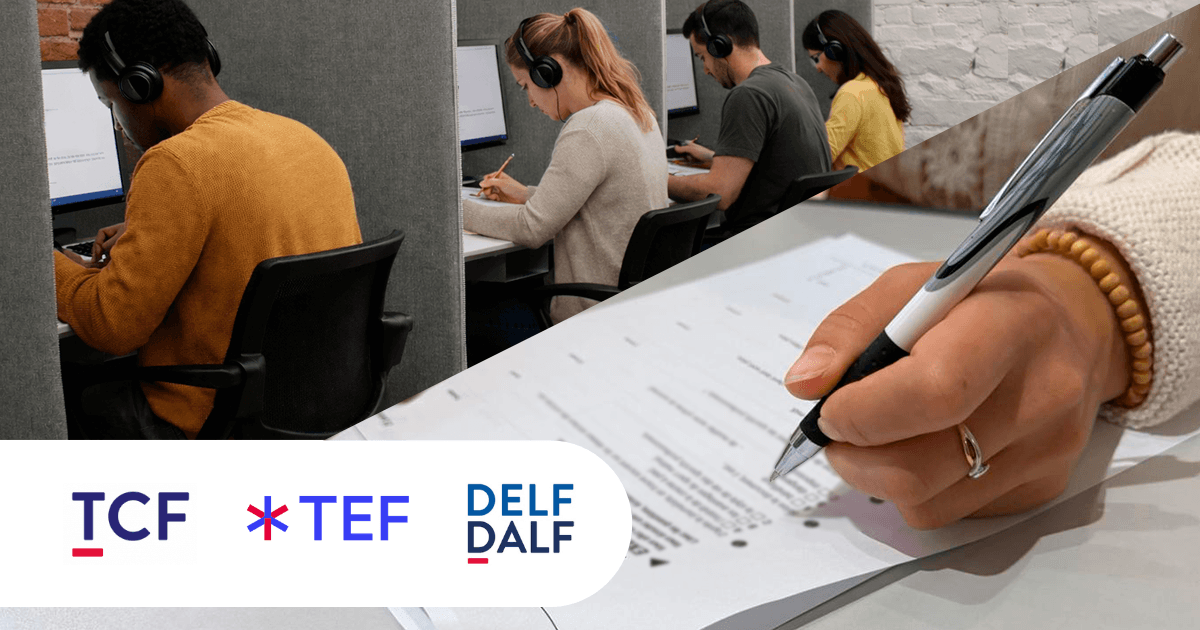
There are several official French language exams, including TEF, TCF, DELF and DALF, each with its own structure, format and evaluation methods.
At the Alliance Française de Montréal, candidates can take a range of these official certifications, depending on the requirements established by institutions such as immigration authorities, universities or employers.
This guide provides a clear and structured overview of each French language exam, focusing on how they are organized, how they are assessed, and what candidates can expect on test day.
Important: the Alliance Française de Montréal does not advise candidates on which exam to take. Candidates are responsible for confirming the appropriate exam with the institution requesting the certification before registering.
Introduction: French proficiency levels (A1 to C2)
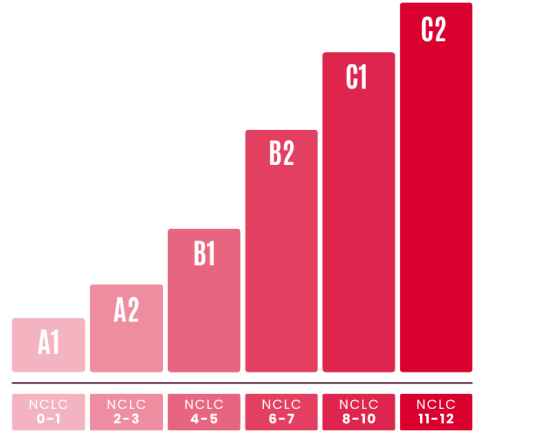
All major French exams such as TEF, TCF, DELF, and DALF are aligned with the CEFR (Common European Framework of Reference for Languages). This framework is an international standard used to describe language ability in a consistent and comparable way across different exams and institutions.
Instead of measuring French “in general terms”, the CEFR breaks proficiency into six clearly defined levels, from beginner (A1) to near-native mastery (C2).
Each CEFR level describes what a learner can actually do with the language in real-life situations:
- A1: Understands and uses very basic expressions for simple interactions.
- A2: Handles everyday situations like shopping and personal information.
- B1: Manages travel and daily conversations, and can express simple opinions.
- B2: Communicates fluently in study/work contexts and understands complex ideas.
- C1: Uses French effectively in academic and professional settings with fluency.
- C2: Near-native level; understands almost everything and expresses ideas precisely.
Why French language exams use CEFR scale
The CEFR exists to create a common language for language ability assessment. This means that whether you take the TEF, TCF, DELF, or DALF:
- Your result can be compared internationally
- Universities, immigration programs, and employers understand your level easily
- Different exams can measure the same skill level in different formats
In addition to the CEFR scale, French proficiency is also assessed through other systems depending on the purpose.
In Canada, for example, immigration programs use the CLB (Canadian Language Benchmarks), while the province of Québec uses its own evaluation scale for immigration and integration purposes.
To better understand how French proficiency levels work across all systems, consult our detailed guide: French Levels Explained: A1 to C2, CEFR, Canada and Quebec Scale.
What Are TEF, TCF, DELF and DALF French Exams?
What is the TCF?

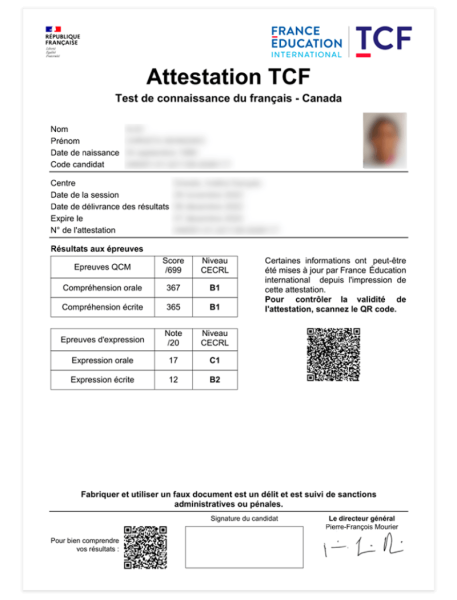
The TCF (Test de Connaissance du Français) is an official French language exam developed by France Éducation International, a public institution under the French Ministry of Education.
More specifically, this standardized test evaluates a candidate’s proficiency through a standardized and calibrated methodology, ensuring consistent results across sessions.
As mentioned earlier, its scoring system is aligned with the CEFR, with results ranging from A1 to C2.
Format and administration
At the Alliance Française de Montréal, the TCF is administered under standardized exam conditions:
- Computer-based format
- Keyboard: QWERTY Canadian multilingue (with numeric keypad) + AZERTY (upon request)
- Comprehension sections completed on computer
- Speaking test conducted with a certified examiner
- All components are typically completed on the same day
Candidates should plan to reserve a full day to complete all sections of the exam.
Results are generally made available for download on the candidate platform approximately 2 to 3 weeks after the examination date, according to processing timelines established by France Éducation International (FEI).
TCF results are valid for two years from the date of the exam.
Did you know?
For TCF, the written expression sections are corrected directly in Paris by France Éducation International (two examiners per script). The oral expression sections are assessed once at the Alliance Française de Montréal, and then again by examiners from FEI.
TCF versions and structure
The TCF is available in several versions, each with a specific structure and combination of test sections, depending on your objective.
TCF Canada
The TCF Canada includes four mandatory sections:
Skill | Duration | Format | Details |
Listening comprehension | 35 min | Group test | 39 multiple-choice questions |
Reading comprehension | 60 min | Group test | 39 multiple-choice questions |
Written expression | 60 min | Group test | 3 tasks |
Speaking expression | 12 min | Individual test with examiner | 3 tasks |
Total TCF Canada duration: approximately 2 hours and 45 minutes.
Price: 390 $ CAD
Important: If a candidate wishes to improve their results, the full exam must be retaken after a minimum waiting period of 20 days.
TCF Québec (TCF QC)
The TCF Québec follows a modular structure. Because the exam content is developed in Quebec, candidates may encounter Quebec French accents, vocabulary, and expressions during the examination.
Candidates may register for one or more components, depending on the required configuration. Each section evaluates a specific language skill:
Skill | Duration | Format | Details |
Listening comprehension | 35 min | Group test | 39 multiple-choice questions |
Reading comprehension | 60 min | Group test | 39 multiple-choice questions |
Written expression | 60 min | Group test | 3 tasks |
Speaking expression | 12 min | Individual test with examiner | 3 tasks |
Total TCF Québec exam time for the 4 tests: 2h30
Pricing (per component):
- Full test (4 components): 390 $ CA
- Listening comprehension: 110 $ CAD
- Reading comprehension: 90 $ CAD
- Speaking expression: 110 $ CAD
- Writing expression: 90 $ CAD
Important: Candidates may retake specific components after a minimum waiting period of 20 days.
TCF IRN (Integration, Residence and Nationality)
The TCF IRN is intended for administrative procedures in France, such as:
- - applying for French nationality
- - obtaining long-term residency
- - validating basic French level for integration programs
This French language exam assesses only language skills, not knowledge of French history, culture or society. It is made up of 4 compulsory tests assessing general French proficiency.
Skill | Duration | Format | Details |
Listening comprehension | 15 min | Group test | 20 multiple-choice questions |
Reading comprehension | 20 min | Group test | 20 multiple-choice questions |
Written expression | 30 min | Group test | 3 exercises |
Oral expression | 10 min | Individual test with an examiner | 3 exercises |
Total TCF IRN exam time: 1h15
Price: 390 $ CAD
TCF Tout Public (General Public)
The TCF Tout Public is the most flexible version: it includes three compulsory tests and optional modules for speaking and writing.
However, the speaking and writing sections may only be taken if the three compulsory tests have already been completed previously or are taken during the same examination session.
Unlike the other TCF versions mentioned previously, this French language test includes an additional section called “Mastery of Language Structures.”
This module assesses your command of French grammar and vocabulary in context, including:
- - sentence structure accuracy
- - grammatical forms and agreements
- - vocabulary usage
- - ability to choose the correct linguistic form in short contextual questions
Please check with your requesting institution to confirm which TCF version is required or best suited for your specific application.
Skill | Duration | Format | Details |
Listening comprehension | 25 min | Group test | 29 multiple-choice questions |
Mastery of language structures | 15 min | Group test | 18 multiple-choice questions |
Reading comprehension | 45 min | Group test | 29 multiple-choice questions |
Written expression | 60 min | Group test | 3 exercises |
Oral expression | 12 min | Individual test with an examiner | 3 exercises |
Pricing (per component):
- 3 mandatory components: 290 $ CAD
- Speaking expression: 110 $ CAD
- Writing expression: 110 $ CAD
What is the TEF?

The TEF (Test d’Évaluation de Français) is an official French language exam created by the Paris Île-de-France Chamber of Commerce and Industry.
In practice, it is widely used to assess a candidate’s level of French across key language skills,including listening, speaking, reading and writing. Like the TCF, results are also aligned with the CEFR scale (A1 to C2).
Format and administration
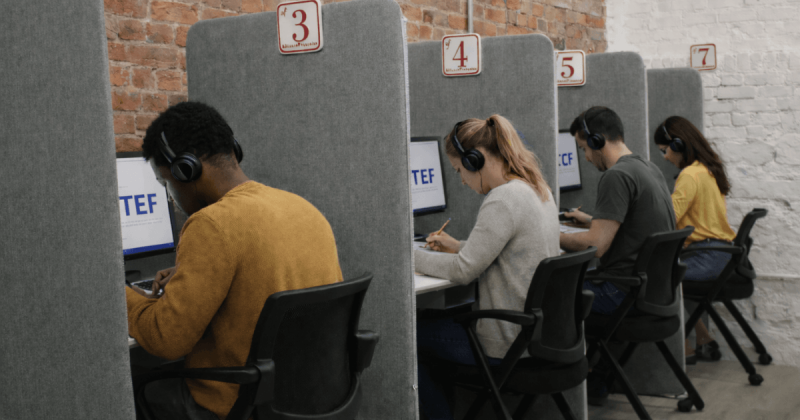
Like the TCF, the TEF is administered in a computer-based format at the Alliance Française de Montréal
- Keyboard: QWERTY Canadian multilingue (with numeric keypad) + AZERTY (upon request)
- Reading and listening sections completed on computer
- Speaking test conducted with a certified examiner
- All components are typically completed on the same day
Candidates should plan to reserve a day to complete all sections of the exam.
Results are generally made available to candidates within approximately 4 to 5 days after the exam session through the official candidate platform. Official attestations may then be downloaded directly by the candidate.
TEF results are valid for two years from the date of the exam, just like the TCF.
Did you know?
For TEF, the written expression sections are corrected directly by CCI Paris Île-de-France (two examiners per script).
The oral expression sections are assessed once at the Alliance Française de Montréal, and then again by examiners from CCI Paris Île-de-France.
There are two formats of the TEF Canada: one for permanent residency applications (with four mandatory tests) and another for Canadian citizenship applications (with only two tests). Check which French language exam you need before registering.
TEF CANADA – PERMANENT RESIDENCE
Skill | Duration | Details |
Listening comprehension | 40 min | 40 questions |
Oral expression | 15 min | 2 tasks |
Reading comprehension | 60 min | 40 questions |
Written expression | 60 min | 2 tasks |
The total duration for the TEF CANADA (4 skills) is approximately 2 hours and 55 minutes.
TEF CANADA – CITIZENSHIP
If you need to take the TEF Canada for citizenship, there are already two oral tests, meaning:
Skill | Duration | Details |
Listening comprehension | 40 min | 40 questions |
Oral expression | 15 min | 2 tasks |
TEF Canada Pricing:
- 4 components: 390 $ CAD
- 2 components (Listening comprehension + oral expression): 195 $ CAD
The TEF Québec (TEFAQ) is specifically designed for immigration to Québec and follows a similar structure, also based on four modules, with it being possible to register for all four tests or for each one individually.
Skill | Duration | Details |
Listening comprehension | 40 min | 40 questions |
Oral expression | 15 min | 2 tasks |
Reading comprehension | 60 min | 40 questions |
Written expression | 60 min | 2 tasks |
For candidates taking the full TEF Québec (TEFAQ), with all four tests, the total duration is approximately 2 hours and 55 minutes.
TEF Québec (TEFAQ) Pricing:
- Full test (4 components): 390 $ CAD
- Listening comprehension: 110 $ CAD
- Reading comprehension: 90 $ CAD
- Speaking expression: 110 $ CAD
- Writing expression: 90 $ CAD
This version is intended for administrative procedures in France, such as:
- – residency applications
- – citizenship requests
- – integration programs
The TEF IRN only assesses up to level B2 (even if your level is higher). The TEF Integration, Residence and Nationality (IRN) consists of 4 mandatory tests:
Skill | Duration | Details |
Listening comprehension | 10 minutes | 17 multiple-choice questions |
Speaking | 15 minutes | 2 tasks (5 minutes each, 10 minutes total speaking time) |
Reading comprehension | 30 minutes | 13 multiple-choice questions |
Writing expression | 30 minutes | 2 writing tasks |
Total exam duration for the 4 tests: 1 hour and 20 minutes.
Price: 390 $ CAD – TEF IRN Registration
What are DELF and DALF?

The DELF (Diplôme d’Études en Langue Française) and DALF (Diplôme Approfondi de Langue Française) are official French language diplomas awarded by the French Ministry of Education. In contrast to the TEF and TCF, which are standardized tests, DELF and DALF are formal diplomas that certify a specific level of proficiency.
Format and administration
At the Alliance Française de Montréal, DELF and DALF exams are administered under official examination conditions established by France Éducation International (FEI).
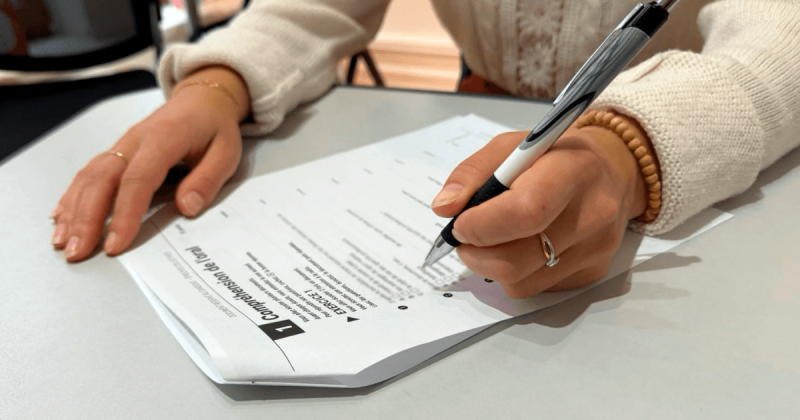
Additionally, these French langague exams are completed entirely on paper rather than on computer, using pen and paper format for all written components. The speaking section is conducted separately with a certified examiner.
Candidates should plan for two separate exam days: one day for collective written examinations one day for individual speaking examinations.
Exam schedules are communicated in advance by the examination centre. In case of success, an official attestation is generally sent by email several weeks after the exam session.
The final diploma is issued directly in France and typically takes approximately four months to arrive.
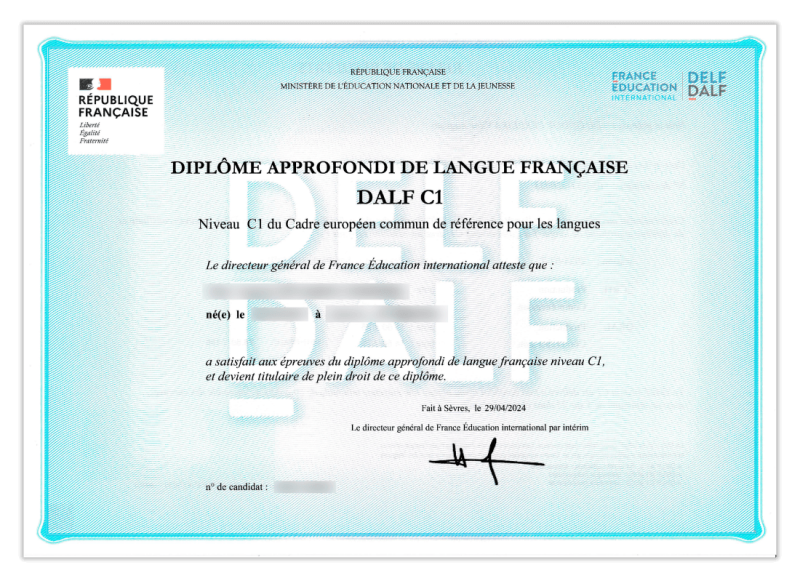
DELF and DALF diplomas are valid for life.
DELF vs DALF: What’s the difference?
Both are designed according to the CEFR scale (A1 to C2), but the DELF and DALF correspond to different levels of proficiency:
- DELF covers beginner to intermediate levels (A1 to B2)
- DALF covers advanced levels (C1 and C2)
Each French diploma is independent, meaning you can register directly for the level that matches your ability, without having to complete previous levels.
How DELF and DALF exams work
Unlike tests such as TEF or TCF, which report results in terms of proficiency levels, DELF and DALF follow a pass/fail system based on both global and sectional performance.
For DELF levels (A1 to B2) and DALF C1, each exam is graded on a total of 100 points and is divided equally across four skills:
- Listening: 25 points
- Reading: 25 points
- Writing: 25 points
- Speaking: 25 points
To pass, candidates must satisfy both conditions at the same time:
- A minimum overall score of 50/100
- At least 5/25 in each individual section
For example, if a candidate scores:
- Listening: 17/25
- Reading: 17/25
- Writing: 17/25
- Speaking: 4/25
Total score: 55/100
Even though the overall result is above the passing threshold, the candidate is still considered unsuccessful because one skill (speaking) is below the minimum required score of 5/25. This rule ensures that candidates demonstrate a balanced competence across all language skills, reflecting real-life communication needs.
Duration and format by level
The duration and complexity of DELF and DALF exams vary depending on the level.
Lower levels assess basic communication, while higher levels require structured argumentation, analysis, and synthesis.
Level | Group exams | Invididual exams | Difficulty |
A1 | ~1h20 | 5 to 7 minutes (+ 10 minutes of preparation) | Basic communication |
A2 | ~1h40 | 6 to 8 minutes (+ 10 minutes of preparation) | Simple everyday situations |
B1 | ~1h45–2h | 15 minutes (+ 10 minutes of preparation) | Independent use of French |
B2 | ~2h30 | 20 minutes (+ 30 minutes of preparation) | Upper-intermediate, structured argumentation |
C1 | ~4h | 30 minutes (+ 60 minutes of preparation) | Advanced, academic-level tasks |
C2 | ~3h30 | 30 minutes (+ 90 minutes of preparation) | Mastery and complex analysis |
For example:
- At DELF A1, candidates complete short tasks focused on everyday communication.
- At DELF B2, candidates must justify opinions and structure arguments clearly.
- At DALF C1, candidates are expected to synthesize complex information and express nuanced ideas in both written and spoken French.
Did you know?
For DELF-DALF exams, written productions are subject to a double correction process at the Alliance Française de Montréal to ensure fairness and consistency.
A third correction may also be required in certain situations, particularly:
– when the two evaluators do not agree on the score
– when the candidate’s final result is close to the minimum passing score of 50/100
Why should you pick DELF or DALF?
If you are interested in the DELF-DALF on your own initiative, without a formal requirement from an institution, university, or government, these French langague diplomas are particularly relevant if your goal is to:
- Study in France or at a French-speaking institution
- Strengthen your CV with an official diploma
- Obtain a long-term certification of your French proficiency
Taking DELF and DALF in Montréal
The Alliance Française de Montréal is an accredited examination centre for DELF and DALF.
Exam sessions are organized 5 times a year (in January, March, June, September, and November), depending on the level and demand. Prices vary depending on the level, as follows:
- DELF A1: $215 CAD
- DELF A2: $215 CAD
- DELF B1: $295 CAD
- DELF B2: $315 CAD
- DALF C1: $385 CAD
- DALF C2: $385 CAD
TEF vs TCF vs DELF vs DALF: Key Differences
The right French language exam depends on your goals, timeline, and the type of certification required by the institution, employer, or government authority you are applying to.
While all four options assess your French level, they differ significantly in format, validity and purpose.
| Criteria | TCF | TEF | DELF | DALF |
|---|---|---|---|---|
| Type | Standardized test | Standardized test | Diploma | Diploma |
| Validity | 2 years | 2 years | Lifetime | Lifetime |
| Levels assessed | A1–C2 | A1–C2 | A1–B2 | C1–C2 |
| Format | Modular | Modular | Fixed exam per level | Fixed exam per level |
| Scoring | Score-based | Score-based | Pass / Fail | Pass / Fail |
| Exam format | Computer-based | Computer-based | Paper-based | Paper-based |
| Keyboard layout | QWERTY | QWERTY | Handwritten responses | Handwritten responses |
| Exam schedule | Usually completed in one day | Usually completed in one day | May take place over one or two days | May take place over one or two days |
| Oral exam | May be scheduled separately | May be scheduled separately | Individual oral interview | Individual oral interview |
| Results | Usually within 2 weeks | Usually within 2 weeks | After at least 1 month | After at least 1 month |
| Official diploma | Not applicable | Not applicable | Up to 4 months | Up to 4 months |
Validity
One of the most important differences between these exams is how long the results remain valid and how they are recognized.
- TEF and TCF results are valid for two years
- DELF and DALF are official diplomas issued by the French government and are valid for life
Structure and format
The structure of each exam also differs significantly:
- TEF and TCF are modular and standardized tests, with formats that vary depending on the requirements of your application.
- DELF and DALF follow a fixed structure, where each level (A1 to C2) corresponds to a specific exam
Scoring systems
Each exam also uses a different evaluation method:
- TEF and TCF are score-based tests that position your level on the CEFR scale
- DELF and DALF are pass/fail exams, requiring a minimum score in each section
How to Prepare for a French Language Exam
Preparing for French proficiency exams such as TCF, TEF, DELF, and DALF requires a combination of official materials, structured practice, and real exam simulation.
The most effective preparation strategies focus on familiarizing yourself with the exam format, practicing under real conditions, and developing both written and oral skills.
Below are some of the most effective preparation methods and resources.
Free DELF B2 and TCF Information Webinars
To help candidates prepare with confidence, the Alliance Française de Montréal also offers free information webinars for the DELF B2 and TCF exams. Hosted by a certified French langague examiner, these sessions provide practical preparation advice, a better understanding of the exam format, and the opportunity to ask questions directly to an expert.
Registration is free, and the connection link is sent 24 hours before the webinar.
Use official mock tests
For the DELF-DALF and TCF exams, one of the most reliable ways to prepare for French exams is by using official mock tests provided by France Éducation International. These mock exams help you:
- Understand the structure and timing of each test section
- Get familiar with question formats
- Practice under real exam conditions
They are especially useful, as they reflect the official testing standards.
Meanwhile, for the TEF, Le Français des affaires, which is part of CCI Paris Île-de-France Éducation, provides a range of free resources to help candidates understand the different types of exam tasks, including preparation workshops focused on each skill (listening and reading comprehension, speaking, and writing).
Practice with PrepMyFuture (go-to exam preparation platform)
Another highly effective tool is PrepMyFuture, a comprehensive online platform designed specifically for French exam preparation. It offers:
- Practice exercises for reading and listening comprehension
- Full simulations for TCF, TEF, and DELF (B1–B2 levels)
- Personalized progress tracking
- Exam-style questions aligned with official standards
PrepMyFuture is also available through the Alliance Française de Montréal, making it easily accessible, with unlimited access for one year after activation.
Join exam preparation workshops
Structured workshops are essential for improving productive skills, especially speaking and writing.
The Alliance Française de Montréal offers a variety of exam preparation workshops designed to target specific French language skills, including listening, reading, speaking, and writing. These workshops are available for learners preparing for TCF, DELF, and DALF exams, and are structured to help candidates strengthen both accuracy and exam strategy.
Workshops typically focus on:
- Oral comprehension and speaking practice
- Written production and structured writing techniques
- Grammar, vocabulary, and exam-specific strategies
- Familiarization with official exam formats and expectations
These sessions are led by experienced instructors and are designed to provide targeted support based on your exam goals and proficiency level.
Take personalized French exam preparation courses
For learners who prefer a more tailored approach, the Alliance Française de Montréal also offers personalized coaching sessions.
These courses:
- Are designed based on your target exam (TCF, TEF, DELF or DALF)
- Focus also on your specific weaknesses
- Are available in flexible packages starting from 4 hours
- Are delivered online, allowing you to study from anywhere
- Allow intensive, one-on-one exam preparation with expert instructors
This option is particularly ideal for learners who want targeted improvement in a short period of time.
TCF Speaking Test Simulation
In addition to full preparation courses, the Alliance Française de Montréal now offers the Simulation d’expression orale TCF, a focused oral practice session designed to help candidates prepare more effectively for the speaking component of the exams.
During this 30-minute session with a certified examiner, candidates complete a 15-minute realistic oral simulation and receive personalized feedback, along with a customized improvement plan at the end of the session.
ABC DELF-DALF Preparation Books
For learners preparing for the DELF-DALF exams, the Alliance Française de Montréal also offers the official ABC DELF-DALF preparation books, published by CLE International. This well-known series provides structured practice aligned with the CEFR levels and exam requirements, helping candidates build confidence in all key competencies: listening, reading, writing, and speaking.
The books include a wide range of exercises, sample tasks, and exam-style activities designed to reflect the actual format of the DELF-DALF tests, making them a practical tool for both self-study and guided preparation.
FAQ: French language exams
The TEF and TCF are considered to have a similar level of difficulty. Both assess French proficiency in listening, reading, speaking, and writing. The main difference lies in the test format and scoring system.
The Alliance Française de Montréal does not advise candidates on which exam to take. Candidates are responsible for confirming the appropriate exam with the institution requesting the certification before registering.
TEF and TCF results are valid for two years. Always confirm validity requirements with the relevant authority.
Registration is done online only through the official platform of the Alliance Française de Montréal. You can choose your exam and available session directly on the website.
Register for your exam below:
All exams (TCF, TEF, DELF, and DALF) are held at the Alliance Française de Montréal:
📍 Alliance Française de Montréal
317 Place D’Youville, Suite 100
Montréal, QC H2Y 2B5
DELF and DALF are diploma-based exams aligned with CEFR levels (A1 to C2) and are valid for life. They are paper-based exams and may take longer to process results, with an additional delay of several months to receive the official diploma.
TEF and TCF, on the other hand, are standardized, computer-based proficiency tests commonly used for immigration, study, or professional purposes. They provide faster results, usually within a few weeks, and are valid for a limited period.
DELF and DALF are level-based exams, meaning you must choose your level before registering.
- DELF A1–B2 → beginner to intermediate
- DALF C1–C2 → advanced
Each exam certifies only one level, and you must pass it to obtain the diploma.
Final scores for all French language exams are determined by their respective official organizations — CCI Paris Île-de-France for TEF and France Éducation International (FEI) for TCF, DELF and DALF — ensuring standardized and internationally recognized results.
Still have questions?
If you didn’t find the answer you were looking for, you can check the full FAQ page or contact us directly:
Conclusion
Choosing between TCF, TEF, DELF, and DALF depends less on which exam is “better” and more on the requirements of the institution, university, employer, or immigration authority requesting the certification.
In most cases, candidates do not choose freely between exams, but must first confirm which test is officially required for their specific application. The Alliance Française de Montréal does not advise candidates on which exam to take. It is the candidate’s responsibility to verify the required French language exam with the requesting institution before registering.
Ultimately, each exam assesses French proficiency differently, yet all are aligned with the CEFR framework and designed to evaluate real-life communication skills. Therefore, understanding their differences and selecting the appropriate preparation path is the key to achieving your target score with confidence.
So, with the right resources — from official mock tests and online platforms like PrepMyFuture, to workshops and personalized coaching — you can build a structured and effective preparation plan tailored to your needs.
