If you are learning French in Canada or Québec, understanding French language levels can become confusing.
Depending on the institution, exam, or context, you may encounter different proficiency systems such as the CEFR (A1 to C2), the Canadian CLB/NCLC levels, or the Québec proficiency scale.
This guide explains how these systems work, how they compare, and what learners can generally expect at each stage of French proficiency.
First Of All, Why Are There Different French Language Scales?
Different French language proficiency frameworks were developed to respond to different educational, institutional, and administrative contexts.
The CEFR, the Canadian CLB/NCLC system, and the Québec proficiency scale were created independently and therefore use different structures and terminology to describe language proficiency.
The CEFR: A Common European Framework
The CEFR (Common European Framework of Reference for Languages) was developed by the Council of Europe and officially introduced in 2001.
Its objective is to create a common framework for evaluating language proficiency across different European countries and languages.
Did you know? Although it is widely associated with French levels such as A1, B2, or C1, the CEFR is not specific to French. It is also used for languages such as English, Spanish, Portuguese, German, and Italian.
Because of its standardized structure, the CEFR has become one of the most widely recognized language proficiency frameworks in the world.
Why Canada and Québec Developed Their Own Scales
In Canada, additional language proficiency scales were developed to respond to the country’s bilingual reality, where both English and French are official languages.
The Canadian Language Benchmarks (CLB) and the Niveaux de compétence linguistique canadiens (NCLC) were created to provide standardized evaluation systems adapted to Canadian contexts such as immigration, education, and professional integration.
Québec also developed its own French proficiency framework, mainly used in francization and integration contexts within the province.
Like the Canadian CLB/NCLC system, the Québec scale reflects the province’s specific linguistic and educational realities.
What Is the CEFR Scale (A1 to C2)?
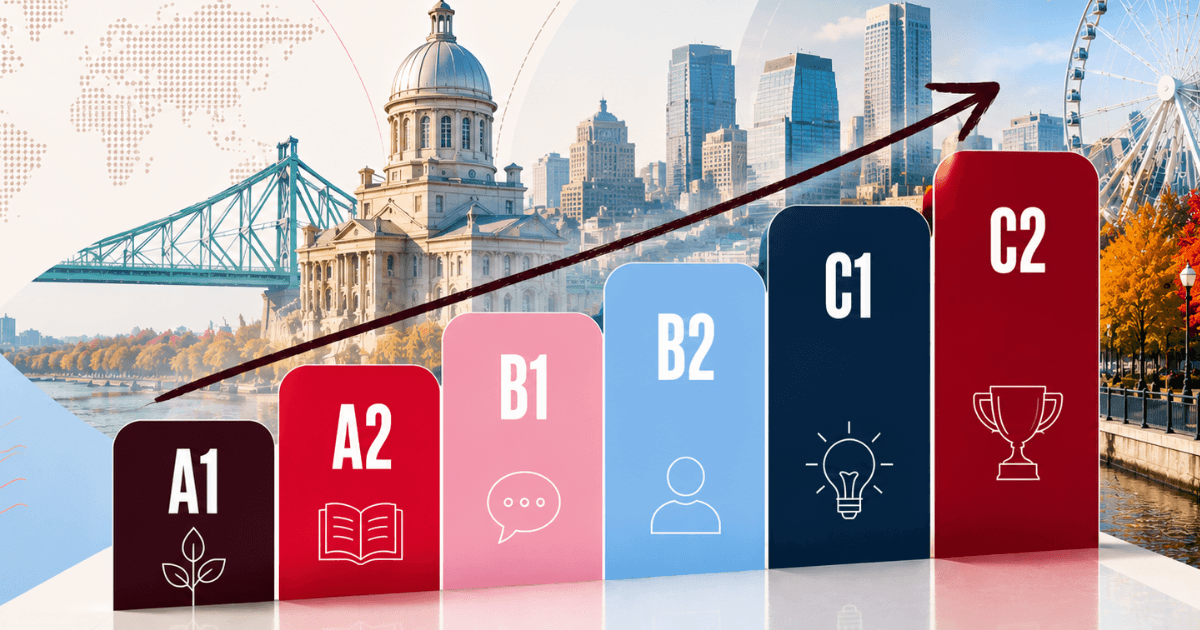
The CEFR organizes language proficiency into six main levels, ranging from A1 (beginner) to C2 (advanced mastery).
These levels describe what learners are generally able to understand, express, and communicate at different stages of language acquisition.
The CEFR is widely used by:
- language schools
- universities
- official examinations
- governments and institutions
The six CEFR levels are generally grouped into three broad categories:
Category | CEFR Levels | General Description |
Basic User | A1 – A2 | Beginner and elementary communication |
Independent User | B1 – B2 | Ability to communicate autonomously in most situations |
Proficient User | C1 – C2 | Advanced communication abilities |
The following sections explain what learners can typically do at each CEFR level from A1 to C2.
Understanding CEFR French Levels from A1 to C2
The CEFR levels are designed to describe how learners progressively develop their communication abilities in real-life situations.
Rather than focusing only on grammar knowledge, each level reflects what learners are generally able to understand, express, and accomplish in French at different stages of proficiency.
Below is a general overview of what learners can typically do at each CEFR level.
A1 French Level (Beginner)
At the A1 level, learners begin to understand and use simple French for everyday situations.
They are generally able to:
- use common words and simple expressions
- introduce themselves and others
- ask and answer basic questions about topics such as home, family, hobbies, or daily life
- communicate in simple situations when others speak slowly and clearly
A2 French Level (Elementary)
At the A2 level, learners can communicate in simple and routine situations about familiar topics.
They are generally able to:
- understand common expressions related to everyday life
- talk about topics such as family, shopping, work, or local surroundings
- exchange simple information in everyday situations
- describe personal experiences and basic needs in simple terms
B1 French Level (Intermediate)
At the B1 level, learners can handle most everyday situations independently.
They are generally able to:
- understand the main points of clear conversations and texts on familiar topics
- manage common situations while travelling
- write simple connected texts on familiar subjects
- describe experiences, plans, and goals, and explain opinions briefly
B2 French Level (Upper Intermediate)
At the B2 level, learners can communicate more confidently and naturally in many situations.
They are generally able to:
- interact fluently with native speakers
- express and explain opinions clearly
- understand more complex texts and discussions
- participate actively in professional or academic conversations
Many learners consider B2 an important step toward fluency in French.
C1 French Level (Advanced)
At the C1 level, learners can communicate effectively in demanding situations.
They are generally able to:
- understand long and complex texts
- express ideas fluently and clearly
- adapt language to professional or academic contexts
- develop detailed and nuanced arguments
C2 French Level (Advanced Mastery)
At the C2 level, learners can understand and express themselves with a very high level of fluency and precision.
They are generally able to:
- understand almost all spoken and written French
- recognize subtle meanings and nuances
- communicate naturally in complex situations
- adapt language easily to different contexts
Although C2 does not necessarily mean native-level proficiency, it represents an advanced command of the language.
How Long Does It Take to Reach Each French Level?
Progressing through CEFR levels generally requires several hundred hours of guided learning and practice.
According to pedagogical estimates commonly used by institutions aligned with the CEFR framework, the number of hours required may vary depending on factors such as:
- study intensity
- exposure to the language
- immersion environment
- previous language learning experience
- native language and other languages already spoken
- frequency of practice
The table below presents approximate guided learning hours often associated with each CEFR level.
Level Progression | Estimated Additional Guided Learning Hours | Approximate Total Cumulative Learning Hours |
A0 → A1 | 80–100 hours | 80–100 hours |
A1 → A2 | 100–120 hours | 180–220 hours |
A2 → B1 | 150–200 hours | 330–420 hours |
B1 → B2 | 150–200 hours | 480–620 hours |
B2 → C1 | 200–300 hours | 680–920 hours |
C1 → C2 | 300–400 hours | 980–1320 hours |
These estimates should be considered general references rather than fixed timelines, as individual progression may vary significantly from one learner to another.
Did you know?
At the Alliance Française de Montréal, French courses are structured according to the CEFR framework, with each level divided into progressive sub-levels tailored to learners’ evolving linguistic skills and communication needs.

What Are CLB and NCLC Levels in Canada?
In Canada, language proficiency is often evaluated using the Canadian Language Benchmarks (CLB) for English and the Niveaux de compétence linguistique canadiens (NCLC) for French. These Canadian frameworks were developed to provide standardized language evaluation systems adapted to the country’s bilingual context, where both English and French are official languages.
Unlike the CEFR scale (A1 to C2), the CLB/NCLC system uses levels ranging from 1 to 12.
These levels are commonly used in contexts such as:
- immigration programs
- language training and francization
- educational evaluation
The CLB/NCLC scales focus on practical communication abilities in real-life Canadian contexts, including workplace, social, and administrative situations.
Like the CEFR, the Canadian system evaluates four core language competencies:
- listening
- speaking
- reading
- writing
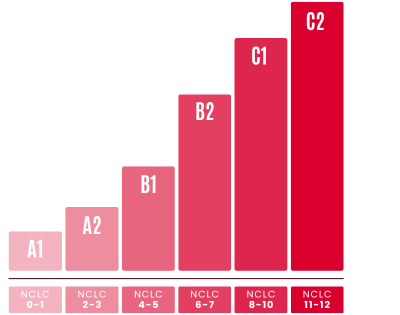
Although approximate equivalencies exist between CEFR and CLB/NCLC levels, the two systems were created independently and do not correspond perfectly level by level. For example, a learner considered B2 under the CEFR framework is often associated with approximately CLB/NCLC 6-7, depending on the evaluation context and competency involved.
What Is the Québec French Proficiency Scale?
In Québec, French proficiency may also be evaluated using the Échelle québécoise des niveaux de compétence en français. This framework was developed specifically for the Québec context and is commonly used in areas such as:
- francization programs
- educational evaluation social and professional integration
- government language programs
Like the Canadian CLB/NCLC system, the Québec scale is organized into 12 proficiency levels. However, the Québec framework was designed to reflect the province’s specific linguistic and cultural realities, particularly in contexts related to integration into French-speaking Québec society.
The scale evaluates practical communication abilities in real-life situations and is frequently used in francization pathways and educational settings throughout Québec.
CEFR vs CLB/NCLC vs Québec Scale
Although the CEFR, the Canadian CLB/NCLC system, and the Québec proficiency scale all aim to evaluate language proficiency, they were developed independently and do not use identical structures or evaluation criteria.
As a result, equivalencies between these frameworks should be understood as general approximations rather than exact conversions.
The table below provides a simplified overview of how these scales are commonly compared in French language learning and evaluation contexts.
| General Level | CEFR | CLB / NCLC | Québec Scale | Typical Abilities |
|---|---|---|---|---|
| Beginner | A1 | CLB 0–1 | Levels 1–4 | Can understand and use basic everyday expressions |
| Elementary | A2 | CLB 2–3 | Levels 5–6 | Can communicate in simple routine situations |
| Intermediate | B1 | CLB 4–5 | Levels 7–8 | Can handle most everyday and work-related situations |
| Upper Intermediate | B2 | CLB 6–7 | Levels 9–10 | Can communicate independently and justify opinions |
| Advanced | C1 | CLB 8–10 | Levels 11–12 | Can communicate fluently in academic and professional contexts |
| Mastery | C2 | CLB 11–12 | Beyond level 12 equivalency | Can understand and express complex ideas with near-native fluency |
Why Are Equivalencies Approximate?
Although these scales often appear comparable, direct equivalencies between CEFR, CLB/NCLC, and the Québec scale are not always exact.
Several factors explain these differences:
- each framework was created for a different context and purpose
- evaluation methods may vary depending on the institution or examination
- some systems use broader levels, while others include more detailed subdivisions
- proficiency may vary between competencies such as speaking, writing, listening, and reading
For example, a learner evaluated at the B2 level under the CEFR framework is often associated with approximately CLB/NCLC 6 or 7. However, the exact correspondence may differ depending on the specific competency being evaluated and the official examination used.
Because of these variations, learners should avoid interpreting language scales as perfectly interchangeable systems.
How Are French Levels Evaluated?
French proficiency can be evaluated through different types of assessments depending on the context, institution, or objective involved.
Some evaluations are designed for official certification, while others are intended for placement, language training, or educational guidance.
Official French Examinations
Several official examinations evaluate French proficiency using recognized language frameworks such as the CEFR or CLB/NCLC equivalencies.
Among the most commonly used French language exams are:
- TEF (Test d’évaluation de français)
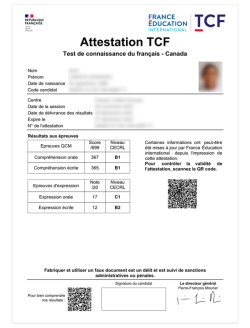
- TCF (Test de connaissance du français)
- DELF and DALF diplomas
Although these examinations all evaluate French proficiency, they differ in structure, scoring systems, validity, and evaluation methods.
Learn more about French language exams in our complete guide:
Placement Tests
At the Alliance Française de Montréal, learners can evaluate their French level through two different placement options:
1 – Online Adaptive Assessment (ELAO+)
The ELAO+ platform uses adaptive technology, meaning that questions automatically adjust according to your answers in order to determine your level more accurately. The evaluation includes:
- listening comprehension
- grammar and vocabulary
- oral expression assessment
- personalized level report
At the end of the test, learners receive a detailed report identifying strengths, weaknesses, and recommended learning pathways.
2 – Oral Test with a Teacher
This evaluation is designed for learners who have already studied French and would like personalized guidance before joining a course at the Alliance Française de Montréal.
Conducted remotely with a teacher, the evaluation lasts approximately 20 minutes and helps determine the learner’s level according to the CEFR framework and the pedagogical structure of the Alliance Française de Montréal.
Book an oral placement evaluation with a teacher
Frequently Asked Questions
What is the difference between CEFR and CLB/NCLC?
The CEFR (A1 to C2) is an international language proficiency framework originally developed in Europe and used for many languages, including French, English, Spanish, and Portuguese.
The CLB (Canadian Language Benchmarks) and NCLC (Niveaux de compétence linguistique canadiens) are Canadian language proficiency systems specifically adapted to the country’s bilingual context.
Although approximate equivalencies exist between these frameworks, they were developed independently and do not correspond perfectly level by level.
What scale is used in Quebec?
In Quebec, several language proficiency frameworks may be used depending on the context.
Educational institutions, language schools, and official examinations often use the CEFR scale (A1 to C2), while immigration, francization, and government-related programs may also refer to the Québec proficiency scale or the Canadian NCLC framework.
The framework used may therefore vary according to the institution, examination, or administrative process involved.
What French level is considered fluent?
The definition of “fluency” may vary depending on the context and the learner’s objectives.
In many educational and professional environments, the B2 level is often considered an important milestone toward functional fluency, since learners are generally able to communicate independently and participate actively in conversations.
However, fluency is not an officially fixed level, and communication abilities may vary significantly from one learner to another.
Is B2 equivalent to CLB/NCLC 7?
B2 is often associated with approximately CLB/NCLC 6 or 7, depending on the competency evaluated and the examination used.
However, these equivalencies are approximate rather than exact, since the CEFR and Canadian frameworks use different evaluation methods and scoring structures.
For example, listening, speaking, reading, and writing scores may correspond differently depending on the official exam involved.
What French scale do official exams use?
Most official French examinations are aligned with the CEFR framework, for example:
- DELF and DALF diplomas are directly associated with CEFR levels from A1 to C2
- TEF and TCF examinations provide numerical scores that are aligned with CEFR levels and can also be converted into CLB/NCLC equivalencies depending on the context.
Different institutions and administrative processes may interpret these results according to their own evaluation requirements.
How can I evaluate my French level?
French proficiency can be evaluated through official examinations, placement tests, or institutional assessments.
At the Alliance Française de Montréal, learners may evaluate their level to identify the most suitable next step in their learning journey — whether it is a course, workshop, preparation program, or official examination:
- oral placement test with a teacher
- official examinations such as TEF, TCF, DELF and DALF
These evaluations help determine a learner’s current communication abilities and recommend the most appropriate learning pathway at the AFMTL.
Understanding French Levels in Practice
Whether through the CEFR framework, the Canadian CLB/NCLC system, or the Québec proficiency scale, French language levels are ultimately designed to describe how learners communicate in real-life situations.
Understanding these frameworks can help learners better interpret exam results, placement evaluations, and learning pathways in Canada and Québec.